Evaluating the Mandala Floral Border Frame for Creative Projects
The Mandala Floral Border Frame represents a specific intersection of geometric symmetry and organic botanical design. For designers, crafters, and small business owners, understanding the utility of these assets is essential before integrating them into a workflow. This collection typically comprises intricate line art that merges the radial balance of a mandala with the soft curves of floral elements, creating decorative borders suitable for both digital and physical applications. When evaluating a bundle of 50 such designs, the focus shifts from mere aesthetic appeal to practical versatility, file compatibility, and alignment with project goals.
Defining the Aesthetic and Structure
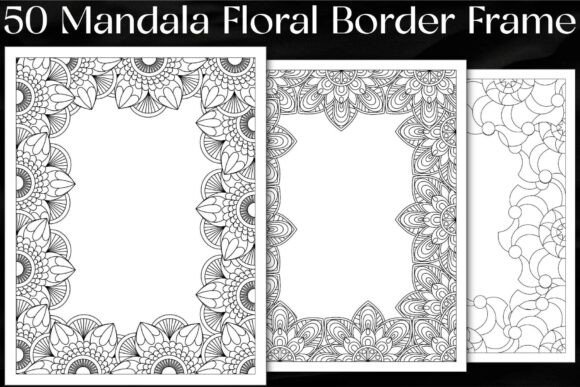
At its core, a Mandala Floral Border Frame is defined by two competing yet harmonious visual languages: the strict mathematical repetition of the mandala and the free-flowing nature of floral illustrations. The "mandala" aspect ensures that the design possesses rotational symmetry, drawing the eye toward a central point or creating a consistent rhythm along a border. The "floral" component introduces variety through petals, leaves, vines, and blossoms, softening the rigid geometry.
In a standard collection of 50 designs, one can expect variations in density, complexity, and framing styles. Some frames may feature heavy, ornate corners with lighter side borders, while others might offer a continuous, uniform pattern ideal for wrapping around circular or square formats. The line art is usually clean and high-contrast, a deliberate choice that facilitates various downstream uses, from laser cutting to sublimation printing. This duality makes the Mandala Floral Border Frame a unique asset that bridges the gap between structured branding and artistic expression.
Practical Applications and Use Cases
The primary reason creators seek out these specific border frames is their adaptability across diverse mediums. The clean line work inherent in these designs makes them particularly strong candidates for several specific scenarios:
- Wedding and Event Stationery: The sophisticated and relaxing visual style aligns well with formal invitations, save-the-dates, and menu cards. The floral element adds romance, while the mandala structure provides a sense of order and elegance.
- Cutting Machines (Cricut/Silhouette): Because these frames are often provided as vector-based line art or high-resolution SVGs, they are ideal for vinyl cutting, paper crafting, and stenciling. The closed paths in the design ensure that intricate petals do not get lost during the weeding process.
- Sublimation and Print-on-Demand: For those creating mugs, tote bags, or journals, the black-and-white nature of the original line art allows for easy recoloring. Designers can overlay these frames onto colored backgrounds or use them as monochromatic accents.
- Branding and Logos: Small business owners in the wellness, yoga, or boutique sectors often utilize mandala-inspired imagery to convey balance and growth. A floral border can serve as a distinctive frame for a logo or a watermark for social media graphics.
Benefits of Using Pre-Made Collections
Opting for a curated bundle of 50 Mandala Floral Border Frame designs offers distinct advantages over creating these elements from scratch. The most significant benefit is time efficiency. Drawing intricate mandalas with perfect symmetry and botanically accurate flowers requires a high level of skill and a substantial time investment. By utilizing a pre-made collection, creators can bypass the drafting phase and move directly to customization and assembly.
Furthermore, consistency is a key advantage. In a professional collection, the line weights, stylistic flourishes, and overall artistic direction remain cohesive across all 50 designs. This allows a brand or a project series to maintain a unified look even when varying the specific frame used. Additionally, the "clean line art" specification mentioned in many collections ensures that the files are optimized for scalability. Whether the frame is shrunk for a sticker or enlarged for wall art, the details remain crisp, avoiding the pixelation issues common in lower-quality raster images.
Considerations and Potential Tradeoffs
While the benefits are clear, there are tradeoffs and considerations that buyers must evaluate to ensure the product meets their needs. One primary consideration is the file format. Not all bundles provide the same types of files. Some may offer only high-resolution PNGs, which are excellent for printing but difficult to edit or scale infinitely without quality loss. Others may include SVG, EPS, or AI files, which are necessary for laser cutting or significant modification. Users must verify that the bundle includes the specific formats required for their intended hardware and software.
Another factor is the level of intricacy. While detailed designs are visually stunning, they can present challenges in certain production methods. For example, in laser cutting wood or acrylic, extremely fine lines between petals may result in fragile pieces that break easily. Similarly, in screen printing, very tight details might clog screens or fail to transfer clearly on textured fabrics. Users should review the complexity of the specific Mandala Floral Border Frame designs to ensure they match the limitations of their production method.
Licensing is also a critical area for evaluation. Most collections allow for both personal and commercial use, but restrictions often apply. Some licenses may prohibit reselling the digital files themselves or using them in "print-on-demand" services where the design is the sole value of the product. It is vital to read the terms of service to avoid intellectual property conflicts.
When to Choose Alternatives
There are situations where a Mandala Floral Border Frame may not be the optimal choice. If a project requires a modern, minimalist, or industrial aesthetic, the ornate and symmetrical nature of mandalas might feel too traditional or busy. In such cases, simple geometric borders or abstract line art would be more appropriate.
Additionally, if a project demands full color integration within the border itself (rather than using the border as a outline for color), a pre-colored illustration set might be more efficient than a line-art bundle that requires manual coloring. Finally, for users who need highly specific, non-symmetrical compositions, the inherent radial symmetry of the mandala format can be restrictive. In these instances, custom illustration or asymmetrical floral clipart would offer greater compositional freedom.
Making the Decision
Deciding whether to invest in a Mandala Floral Border Frame collection comes down to assessing your specific workflow and aesthetic goals. If you operate in niches like wedding planning, holistic wellness, or handmade crafts, this asset type is likely a strong fit. The combination of floral elegance and mandala symmetry offers a timeless appeal that resonates with audiences seeking beauty and balance.
Before purchasing, evaluate the technical specifications: ensure the file formats match your tools (e.g., SVG for cutters, PNG for web), check the resolution for print clarity, and confirm the licensing terms align with your business model. If the collection offers a wide variety of densities and shapes within the 50-design limit, it provides a robust toolkit for diverse projects. However, if your work leans heavily toward ultra-modern minimalism or requires complex, non-symmetrical layouts, you may find better value in alternative graphic resources. Ultimately, these frames serve as a versatile foundation, capable of elevating simple projects into sophisticated artwork when applied with intention and technical awareness.